Research question
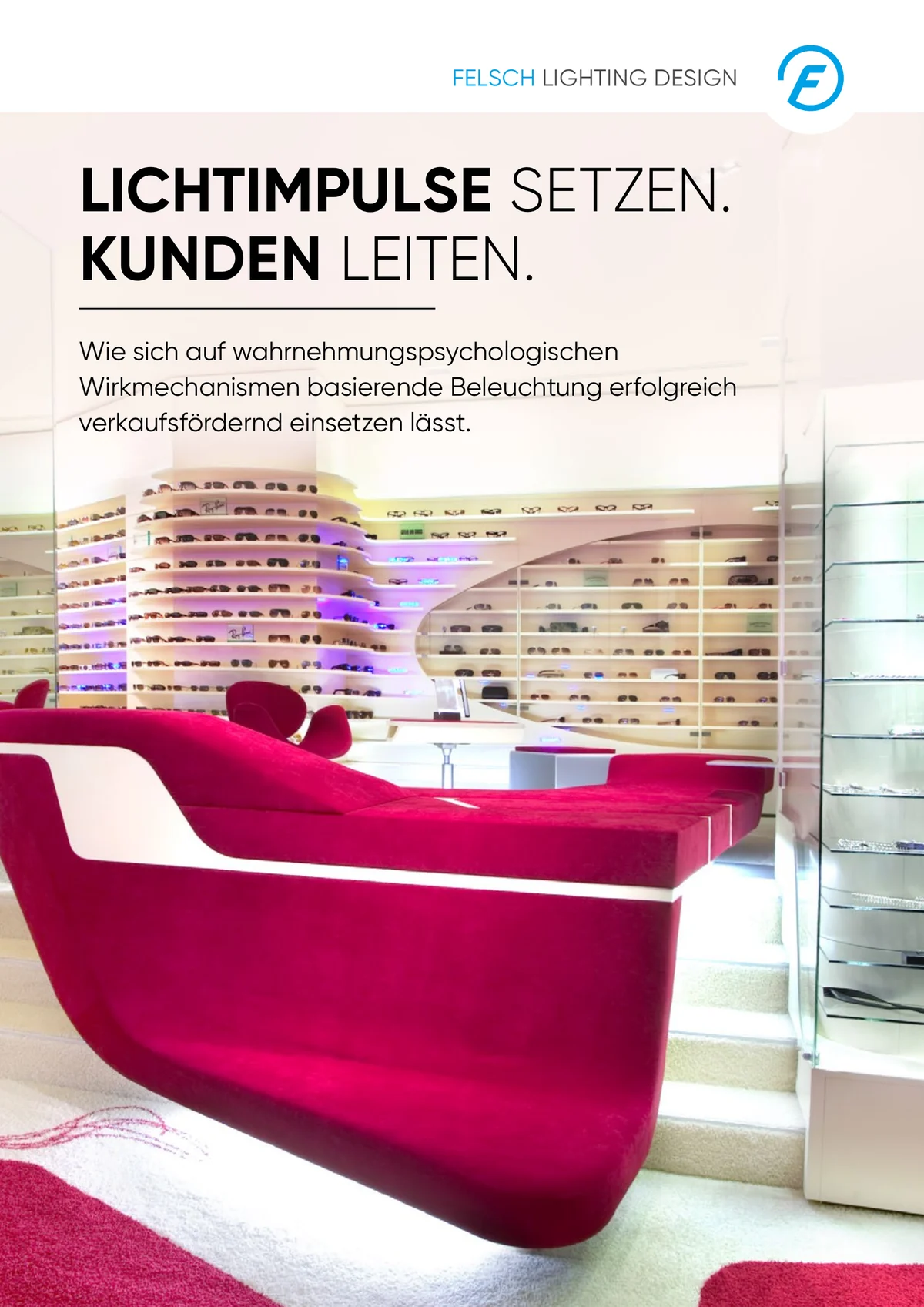
How do lighting conditions affect customer behaviour in bricks-and-mortar retail? The field test combines real sales conditions with scientific methodology. Eye tracking was used to analyse gaze paths in an optician's shop in order to test how targeted lighting design influences length of stay, movement patterns and interaction with products.
Design principles applied
- Activate secondary sales areas: shelf areas above and below eye level are accentuated with dynamic light.
- Light intensity increases with the depth of the room.
- Horizontal presentation surfaces form the focus of the lighting.
- Aisles are not lit separately (diffuse stray light and mirror lighting).
- Defined colour sequences with highlights in the white range and flashes of light in the depth of the room.
- The dynamic sequence is matched to the time spent in the shop, with different colour sequences and longer intervals at night.
- Low energy use thanks to minimal general lighting.
The four design rules
Three-of-five rule. On average, people look more often at the upper part of a surface. To draw attention downwards, the lower three fifths are accentuated. For children, the measures must be stronger.
Moderation rule. Viewers no longer register very fast or very slow light changes. The average time spent at a product is the upper limit for the frequency, and the average time spent in the shop is the lower limit for a sequence.
Brightness step rule. According to Stevens' power law, changes in the upper brightness range are perceived disproportionately weakly, and in the lower range disproportionately strongly. Large perceived differences therefore arise at the lower end of brightness perception.
555 rule. The eye perceives light around 555 nm (yellow) as much brighter than light at the edges of the spectrum. Yellow light on the display fixture or a surface close to it guides the eye to the product, and dynamically also in contrast to blue-red colour sequences.
Results of in-store research
Studies in the USA show that customers walk more slowly when individual displays are lit in colour: viewing time within a radius of 3 to 4 metres increased by 10 to 15 seconds. Dynamic light in the entrance increased visitor numbers by 25 %. 13 % of customers chose the exit with coloured dynamic lighting. Product touches rose at times by 7 %, looking around the room by 25 % and sales by 6 %. An accent illuminance 60 % lower was enough for the same effect.
The field test
After an introduction and calibration, ten test subjects were asked to choose a pair of glasses for themselves. There were no further instructions or time limit. The gaze points were transferred point by point to a floor plan and connected in the order in which they were viewed. This makes it possible to distinguish areas that received little attention from those that were looked at intensively.
Evaluation and conclusion
Bright and colour-accented zones were looked at more often and for longer than diffusely lit areas. In the entrance area, dynamic light sequences led to greater attention and influenced walking direction. In colour-accented surroundings, the viewing time of individual products rose measurably, and the change from cool to warm light altered the emotional effect. Light therefore influences gaze behaviour, orientation and length of stay. Planned deliberately, it highlights products, structures routes and controls the atmosphere – with lower energy use.