White paper · Felsch Lighting Design

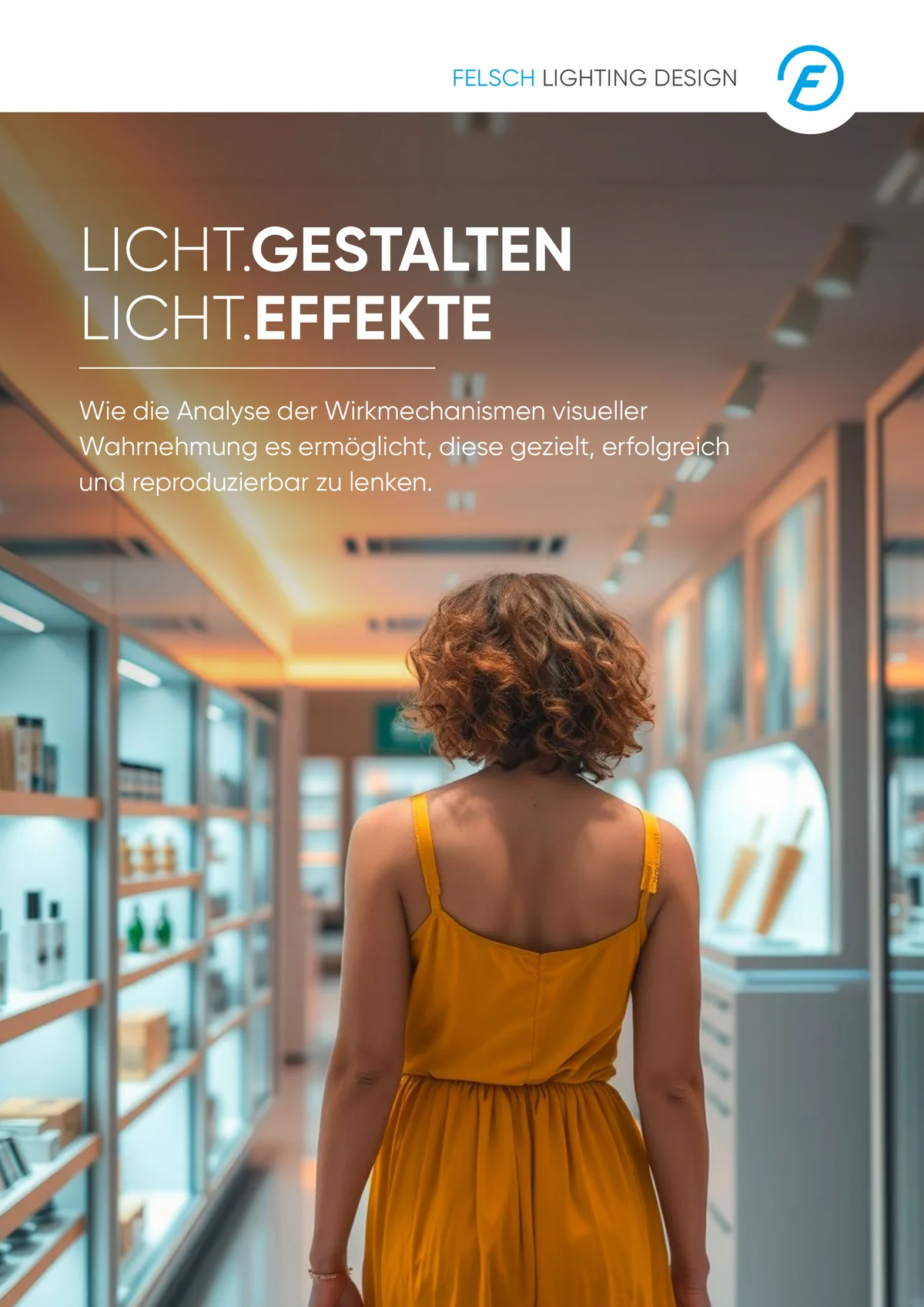
Designing light, light effects

How analysing the mechanisms of visual perception makes it possible to guide attention in a targeted and reproducible way

Author: Markus Felsch, Prof. Dr.-Ing. Roland Greule, Dipl.-Ing. Thomas Lemke, Sergej Batov · Published: · Updated:

Cover: Designing light, light effects

Abstract

Around 80 % of our perception is visual, and its most important medium is light. In a laboratory study in the virtual studio of HAW Hamburg, Felsch Lighting Design and HAW used eye tracking to examine how 19 test subjects react unconsciously to light stimuli: to size, position, brightness, contrast, colour, movement and dynamics. The first glance usually went to the upper left, and movement and strong brightness contrasts were detected fastest. Recommendations for active light guidance are derived from this.

Key findings

  1. Regardless of content, the first glance usually goes to the upper left half of the image. In standardised situations, visual attention follows spatial routines.
  2. Movement and strong brightness contrasts are detected fastest and lead to longer fixations. Even movement with very low contrast was detected and followed by all test subjects.
  3. Not everyone perceives subtle stimuli such as colour differences or brief flashes. On average, men reacted slightly faster and more often to short-term changes.
  4. With text and image, women more often chose the text as their first fixation point, while men reacted more strongly to changes in the image.
  5. Very slow changes are not noticed by everyone, but more than half still detected changes lasting ten seconds.
  6. No particular size, brightness or colour is preferred for the first glance – position and dynamics are more effective.

Background

Visual perception accounts for around 80 % of our overall perception. Light conveys information about sizes, surfaces, materials and colours. Lighting technology is constantly changing, but the principles of perception remain the same. Even so, the relationship between lighting design and the visual perception of space had hardly been studied scientifically. In the laboratory, the unconscious, “pure” reaction of the eyes to differently designed light stimuli could be measured for the first time.

Passive and active lighting

Passive lighting presents things and highlights their properties – through light colour, characteristics, direction and intensity. With active lighting, light itself becomes a design parameter that determines the message, feel and mood of a space. In retail in particular, shops have developed from passive sales areas into active experience worlds.

Fundamentals of vision

The visual field of both eyes covers about 180° horizontally and 150° vertically. We only see sharply within 1 to 2°; at 8° around 20 % of visual acuity remains, and we distinguish colours up to about 120°. Eye tracking overlays the image seen with the point of focus and so shows which information is actually taken in.

Test set-up

An automated presentation showed test panels on size comparison, position of the first glance, text versus visual stimulus, brightness, contrast, movement at low contrast, colour, warm and cool spots on a coloured background, and dynamics. The first glance, the attention threshold for dynamic changes and the gaze duration for periodic changes were evaluated.

Results in detail

  • Size: no preference for larger or smaller luminous areas of the same luminance, but a tendency towards the left-hand object.
  • Position: a clear preference for the upper left; points in the upper half of the image are more likely to be looked at. Changes are usually detected within four seconds.
  • Text versus stimulus: briefly displayed points next to a text were detected by 6 of 19 people, 5 of them men.
  • Brightness, contrast, colour: no preference for particular values, but a clear tendency towards the upper left.
  • Movement: detected by everyone even at very low contrast and followed for the entire duration.
  • Warm and cool spot: no correlation with the background colour; attention lies above the centre between the spots.
  • Dynamics: not everyone notices very slow changes; changes lasting ten seconds were still noticed by more than half.

Conclusion

With targeted light stimuli – through placement, contrast, colour and movement – gaze paths can be planned and attention guided reproducibly. The results feed into space-specific recommendations for deliberate lighting design and form the basis for the field test in retail.


“The interplay of light and shadow creates the contrast in which the message emerges.”

Markus Felsch

Would you like to guide perception deliberately in your project?

Key terms

Eye tracking
Recording of eye movements, overlaid on the image seen, to determine the point of focus.
First glance
Position of the first fixation after a new stimulus appears.
Attention threshold
Time until a dynamic change is detected first.
Active lighting
Light as a design parameter in its own right that determines the mood of a space and guides the eye.

Frequently asked questions

Where does the first glance go in a room or on a surface?

In the study, usually to the upper left, regardless of content.

Which light stimuli are perceived fastest?

Movement and strong brightness contrasts. Movement was detected by all test subjects even at very low contrast.

How fast should dynamic light change?

Not too slowly: only just over half noticed changes lasting ten seconds. For retail, the moderation rule from the Opticon field test applies.

Would you like to guide perception deliberately in your project?

Enquire

More white papers

All white papers